
 kna
Published 10 November 2026. Updated 10 November 2026. Editorial team
Double glazed windows have two panes sealed around a gap of dry air or gas. Where the sun is strong, the figure that matters most is the solar heat the glass lets in, the g-value or SHGC: the lower it is, the cooler the room. The other figure is the U-value: heat passing through the glass.
In short
- Two figures describe the glass: g-value for sunlight heat, U-value for heat through the glass.
- Low-E and solar control coatings change the g-value far more than an extra pane.
- A third pane adds weight: the frame and hinges must carry it.
- Laminated glass holds together when broken and helps against noise.
- Moisture between the panes means the seal has failed.
What is a double glazed unit made of?
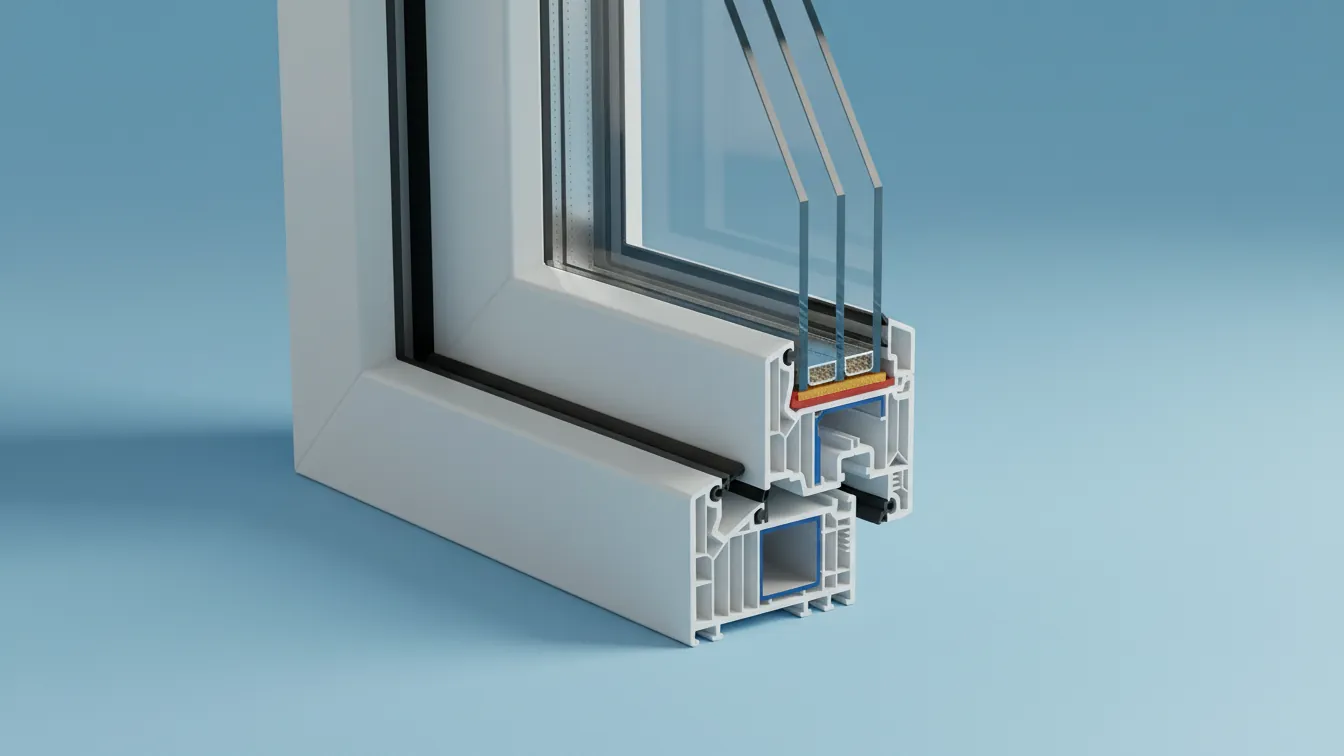
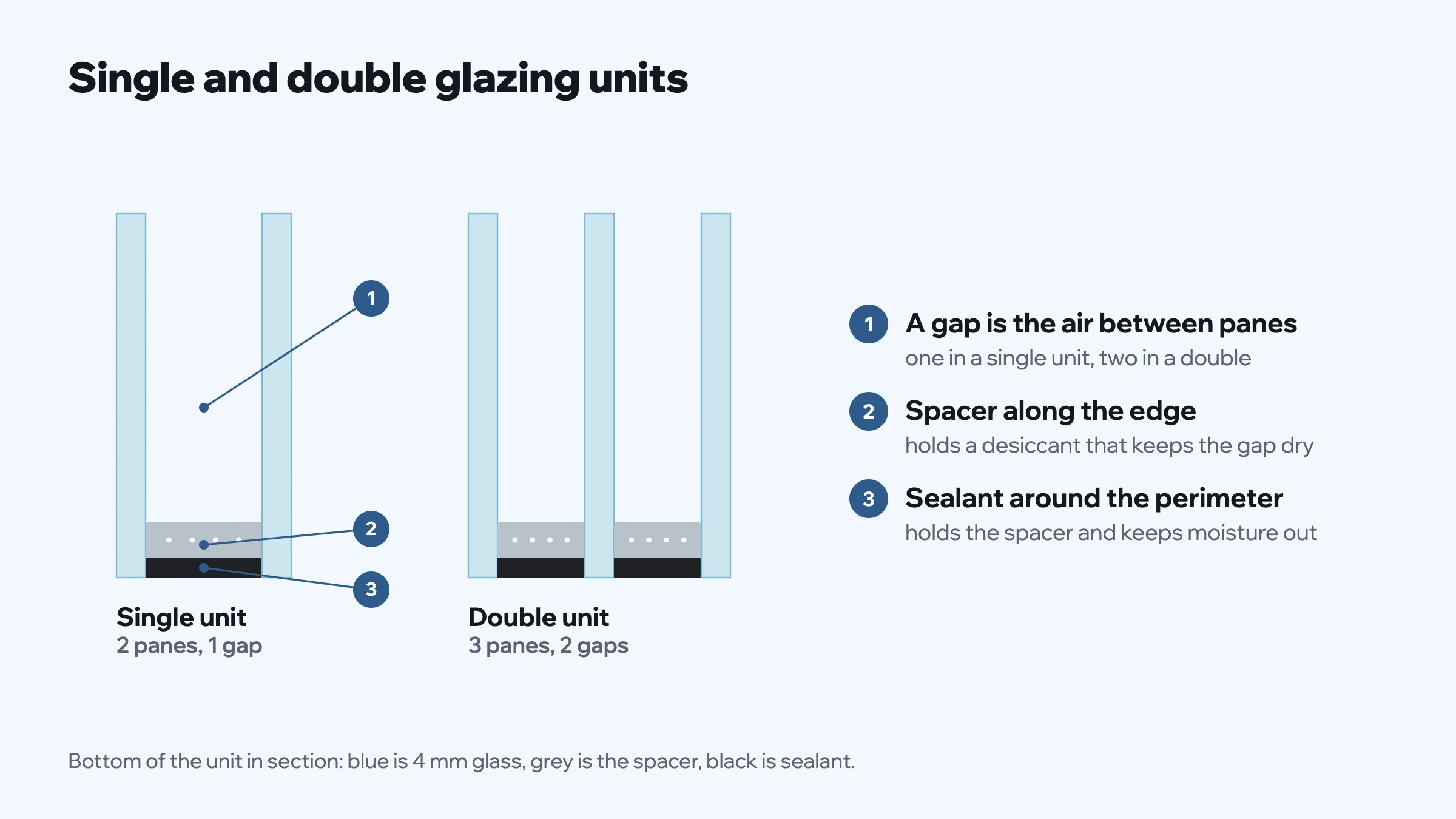
Two panes of glass are held apart by a spacer bar running round the edge. The spacer is filled with a desiccant that keeps the gap dry, and the edge is closed by two seals: an inner butyl seal and an outer sealant that holds the unit together. In Europe, insulating glass units are covered by EN 1279, which sets the system description, tolerances and visual quality.
A triple unit has three panes and two gaps. Four panes or more are made by agreement with the factory.
How do you read the glass formula?
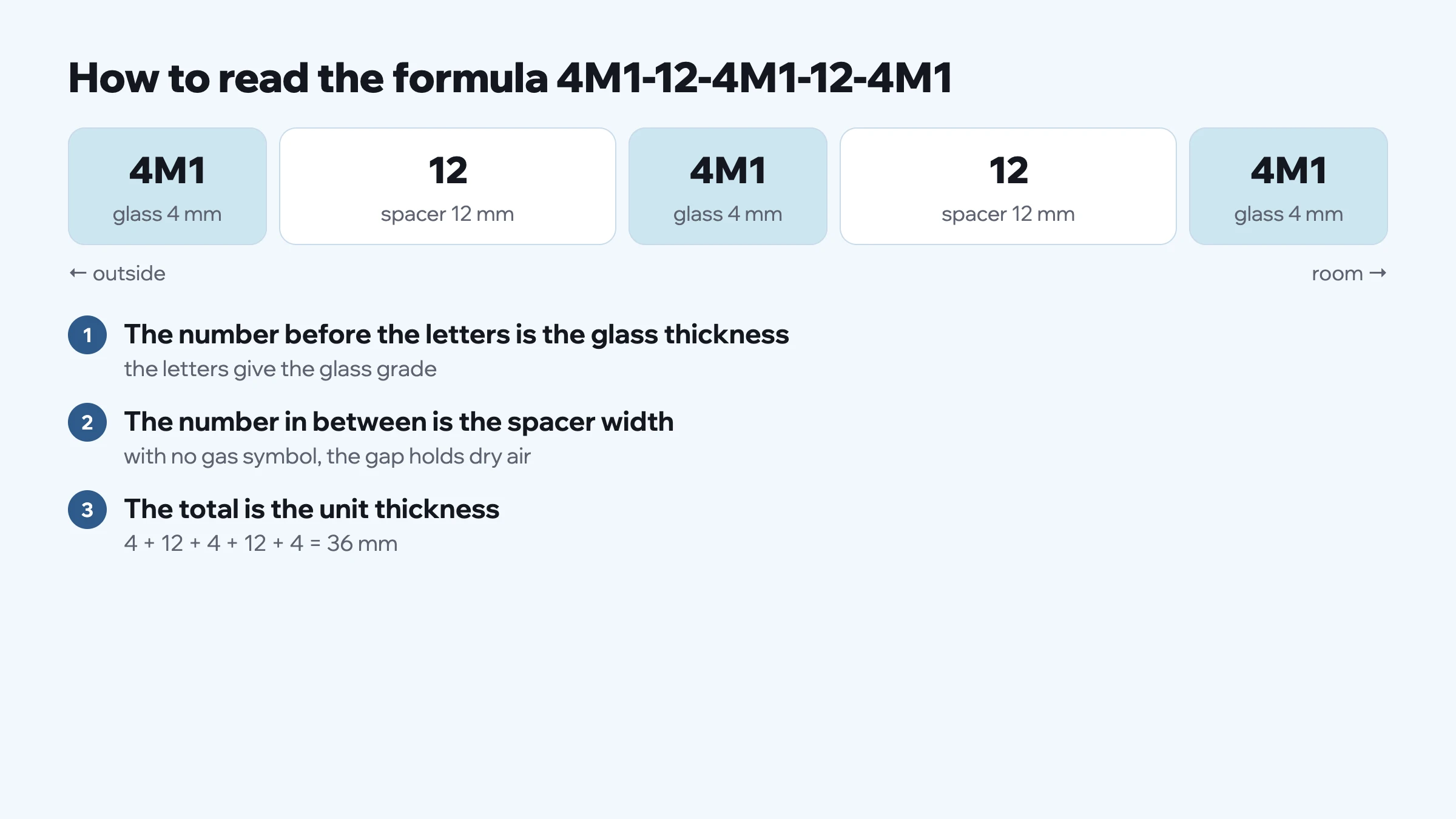
The formula lists the layers from the outside in. A pane is written as its thickness in millimetres plus a code for the glass type; the number between panes is the spacer width. A letter after the spacer names the gas: Ar for argon, Kr for krypton. No letter means dried air.
The Russian standard GOST 24866, for example, uses 4M1-12-4M1-12-4M1: three 4 mm panes and two 12 mm gaps, 36 mm in total. Ask for the formula of your unit in writing, with the coating and the surface it sits on.
Which figures describe the glass?
| Figure | What it shows | Better when | Standard |
|---|---|---|---|
| g-value (SHGC) | Share of solar energy that passes into the room | Lower, in a sunny climate | EN 410 |
| Light transmittance | Share of daylight that passes through | Higher, if the room should stay bright | EN 410 |
| U-value | Heat passing through the centre of the glass | Lower | EN 673 |
| Rw | Airborne sound insulation in decibels | Higher | ISO 717-1 |
The g-value runs from 0 to 1. At 1.0 all solar energy passes through; most windows sit between 0.2 and 0.7. The American SHGC is in practice the same figure. The Abu Dhabi green building rating Estidama defines SHGC as the share of solar heat entering a space through glass compared with the solar radiation falling on it, and lists glazing SHGC among the passive design measures that cut a building's heat gain.
Note that the EN 673 U-value is calculated for the centre of the glass. Spacers and the frame are left out, so the whole window performs differently. Ask for the window U-value as well if it matters to you.
What does low-E glass do?
A low-E coating is a thin layer on the glass that reduces how much infrared heat the surface radiates. Heat tends to stay on the side where it came from, while visible light passes through. In a hot climate, that means outdoor heat stays outside.
There are two main kinds. Pyrolytic coatings are applied at the float glass plant while the glass is made. Sputtered coatings are thin silver layers; they are less stable in open air, so they always face into the sealed gap of the unit. Ask which surface carries the coating: surfaces are counted from the outside, 1 to 4 in a double unit.
Tinted, reflective or solar control glass?
All three lower the g-value, in different ways. Tinted glass absorbs part of the sunlight in the pane itself. Reflective glass sends part of it back outside and looks mirror-like from the street. Solar control coatings aim to block heat while letting through as much daylight as possible. EN 410 covers the luminous and solar figures of all these types, so ask for the g-value and light transmittance of the exact build.
Darker glass is not always cooler for the room: compare the g-value, not the colour. And check light transmittance too, or the room may need electric light during the day.
Triple glazing vs double glazing
A third pane mainly lowers the U-value, the heat conducted through the glass. Solar heat entering with sunlight is described by the g-value, which depends mostly on coatings and tint. In strong sun, a well-chosen double unit with a solar control coating can do more for comfort than a plain triple unit.
Weight is the other point. A third pane of the same thickness means half as much glass again, and a thicker unit needs a frame that can hold it. Frame systems state the thickest glazing they accept: in manufacturers' data sheets, the figures run from 32 mm for entry-level frames to 40 to 53 mm for deeper ones. Check that the sash and hinges are rated for the unit.
Argon or air?
Argon lets through about 67 % as much heat as air, and krypton about half as much as argon, so both lower the U-value. A gas-filled unit should be close to full at the start: the Russian standard, for example, asks for at least 90 % inert gas. The gas does not change the g-value much; coatings do.
Which glass helps against noise?
Units with panes of different thickness, or with laminated glass, block sound better than units with identical panes. The figure to ask for is Rw from a laboratory test of the exact build. Without a test report, a "noise reduction" label means little.
Which glass is safe?
Glass should not injure people if it breaks. Toughened glass, described in EN 12150-1 as thermally toughened safety glass, breaks into small pieces. Laminated glass is two or more panes bonded with a polymer interlayer that holds the fragments in place. Ask for one of them in doors, low windows, children's rooms and wherever someone could fall against the glass.
Double glazing in Dubai and Abu Dhabi: what to ask for
- The g-value (SHGC) and light transmittance of the unit, especially for south and west facing windows.
- The U-value, and which standard it was calculated under.
- The coating type and the surface it is on.
- Safety glass where it is needed, and the Rw if the home faces a busy road.
- Whether the frame system accepts the unit's thickness and weight.
Window companies and their prices are compared in the Dubai window company ranking.
How do you check a glass unit on delivery?
- No dust, cracks, chips or loose sealant inside or around the edge.
- No moisture or mist between the panes.
- The unit rests on setting blocks at least as wide as the unit.
- Faint rainbow lines (Brewster fringes) are acceptable. Coloured rings in the middle (Newton rings) mean the panes touch.
Clean the glass with a soft cloth and a cleaning liquid, with no hard brushes or abrasives. The whole window is checked by the window installation checklist.
Questions to ask the installer
- What is the glass formula, layer by layer?
- What are the g-value, light transmittance and U-value?
- Is there a low-E or solar control coating, and on which surface?
- Is the gap filled with gas, and which?
- Will the sash and hinges carry the weight?
The frame is compared in aluminium vs uPVC windows, and heat protection as a whole in windows for hot climates.
Questions and answers
What is double glazing?
Two panes sealed around a gap of dry air or gas, held apart by a spacer bar with desiccant.
Is triple glazing better than double glazing?
It conducts less heat but is heavier. Against strong sun, the coating and the g-value matter more than the number of panes.
What is a good g-value for a hot climate?
The lower the g-value, the less solar heat enters. Compare units by their g-value and light transmittance together.
What does low-E mean?
Low emissivity: a coating that radiates little infrared heat, so heat stays on the side it came from.
Why is there mist between the panes?
The edge seal has failed, and moist air has got in. The unit needs replacing.
Sources
- European standards EN 1279-1 (insulating glass units), EN 673 (U-value of glazing), EN 410 (luminous and solar characteristics), EN 12150-1 (toughened safety glass); ISO 717-1 (sound insulation). Pearl Building Rating System, Design and Construction, version 1.0, Abu Dhabi Urban Planning Council. Russian standard for glazing units. Reference articles on solar gain and low-E coatings. Frame system data sheets. Checked in November 2026.