
 kna
Published 10 November 2026. Updated 10 November 2026. Editorial team
The best windows for a home come down to four things: the frame, the glazing unit, the installation and the contract. Ask for the window's tested classes for air permeability, watertightness and wind resistance under European standards, and for its sound insulation in decibels. Thermally broken aluminium and uPVC both qualify once these figures are written into the contract.
In short
- Ask for test classes, not adjectives like "airtight" or "storm-proof".
- Sound insulation is a single figure, Rw, measured in a laboratory.
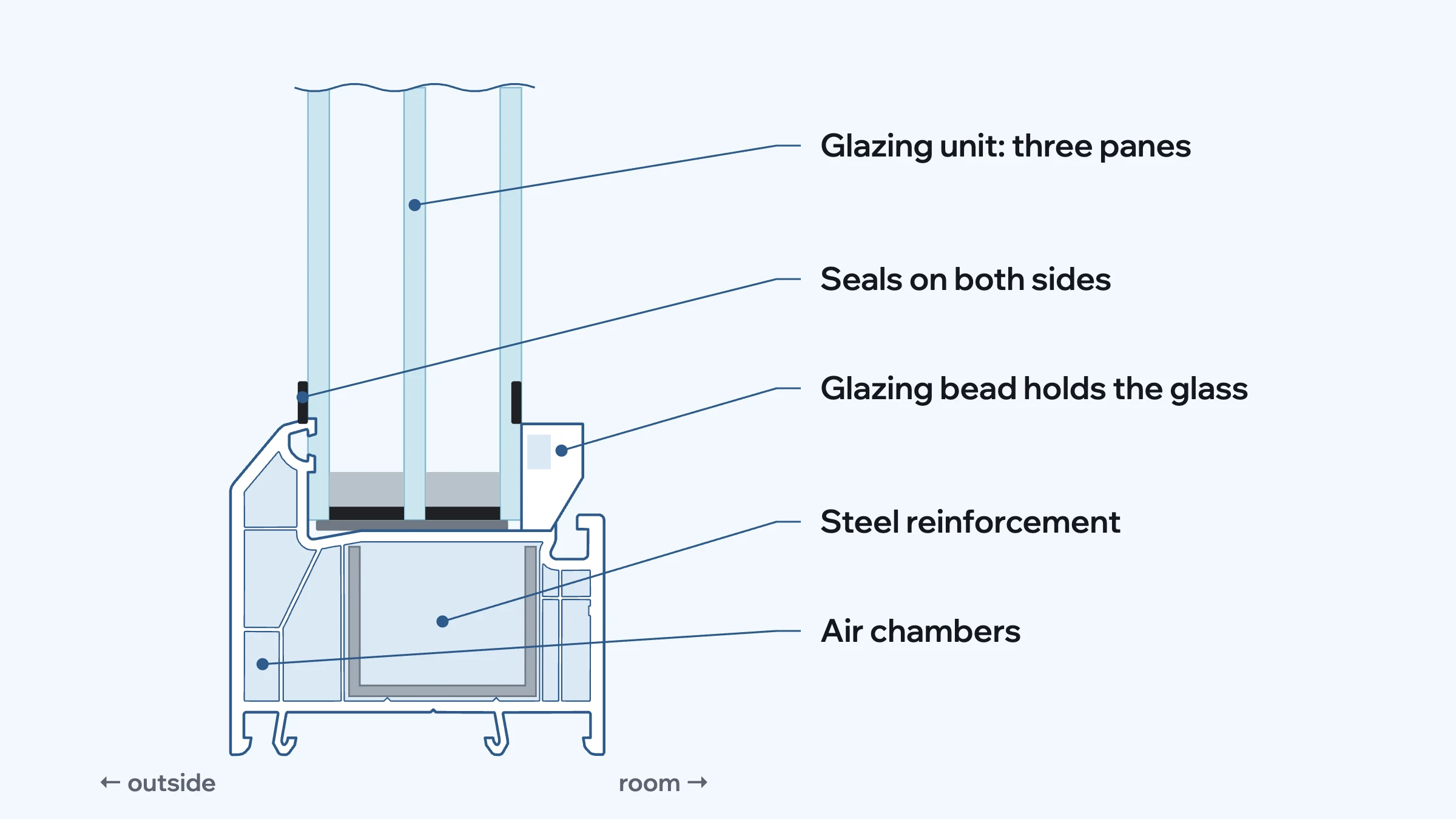
- A single glazing unit has two panes, a double unit has three.
- The joint between frame and wall is built in layers.
- The model, specification and warranty go into the contract.
To compare installers on equal terms, use the Dubai window company ranking: each company's total score and its weaker points.
Aluminium or uPVC?
Both are common, along with timber and combined frames. The job decides the material, and its properties are checked against the product data sheet.
| Material | What to check | Document |
|---|---|---|
| Aluminium | A thermal break between the inner and outer profile: warm system or cold | Manufacturer's catalogue |
| uPVC | Wall thickness, climate rating | Frame marking |
| Timber | Species, laminated or solid section, repainting interval | Manufacturer's instructions |
Whatever the material, the same questions apply: which test classes the window reached, what the glazing unit is made of and how it will be installed. The two main frame materials are compared in aluminium vs uPVC windows.
Which performance figures should you ask for?
In Europe, windows and external doors are covered by the product standard EN 14351-1, which lists their performance characteristics. Three of them come from separate tests, each with its own classification:
| Property | Test | Classification |
|---|---|---|
| Air permeability | EN 1026 | EN 12207 |
| Watertightness | EN 1027 | EN 12208 |
| Resistance to wind load | EN 12211 | EN 12210 |
Each classification applies to a completely assembled window of any material. Ask which class the offered window reached in each test, and for the test report on that system.
How do you know a window will keep noise out?
Look for Rw, the weighted sound reduction index from ISO 717-1. It is a single figure in decibels, measured in a laboratory, so it describes the window itself rather than the finished wall. If the home faces a busy road, ask for the Rw of the exact window and glazing you are buying, not a promise of "quiet windows". The installation matters too: the middle layer of the joint damps sound.
How thick should uPVC frame walls be?
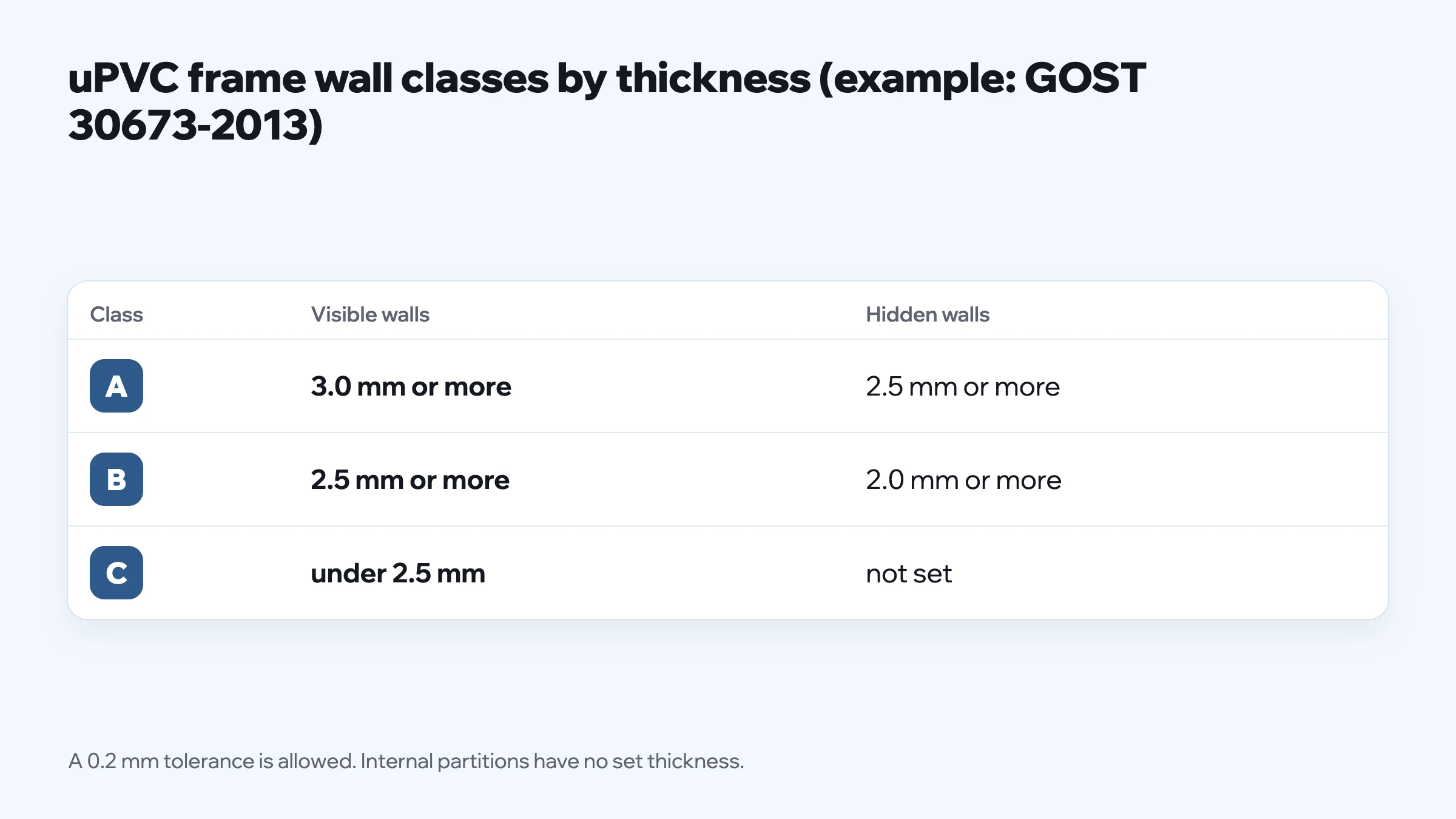
Standards sort uPVC frames by wall thickness. The Russian standard GOST 30673, for example, sets three classes:
| Class | Visible walls, mm | Hidden walls, mm |
|---|---|---|
| A | 3.0 or more | 2.5 or more |
| B | 2.5 or more | 2.0 or more |
| C | under 2.5 | not set |
A tolerance of 0.2 mm is allowed, and internal partitions have no set thickness. The hollow spaces inside are called chambers; their number varies from series to series. Check the figures against the manufacturer's documents.
Single or double glazing unit?
A glazing unit is made of panes held apart by spacer bars. A single unit has one gap, a double unit two.
The formula is read from outside to inside. Take 4M1-12-4M1-12-4M1: three 4 mm panes with two 12 mm spacers, 36 mm in total. A symbol after the spacer width names the gas fill, for example Kr for krypton. Ask for the formula in writing, together with any energy-saving coating on the glass. Glazing options are explained in the guide to double glazed windows.
Which seals hold up in heat?
The gap between sash and frame is closed by elastic seals, and the manufacturer sets how many seal lines there are. Seals differ by polymer and by the highest temperature they are rated for. The Russian standard GOST 30778 rates EPDM, silicone and chloroprene seals up to +80 °C and thermoplastic elastomers up to +70 °C. Ask which polymer the offered window uses.
Which opening type and hardware?
A sash can be fixed, side-hung, tilt and turn or sliding. A fixed sash cannot be opened, so cleaning it from outside on a high floor is awkward. The tilt position lets air in without swinging the sash wide open.
Hardware means hinges, handle and locking points. Ask who makes it, how many locking points there are and whether the first adjustment is included.
What should you order at the start?
Insect screens, a child lock on the handle, a slot ventilation setting and a trickle vent are usually extras. Decide early so they appear in the first quote.
How will the room breathe after replacement?
A sealed window lets less air through. Adjustable sash opening and built-in trickle vents keep the air and humidity in check.
Why does the installation joint matter?
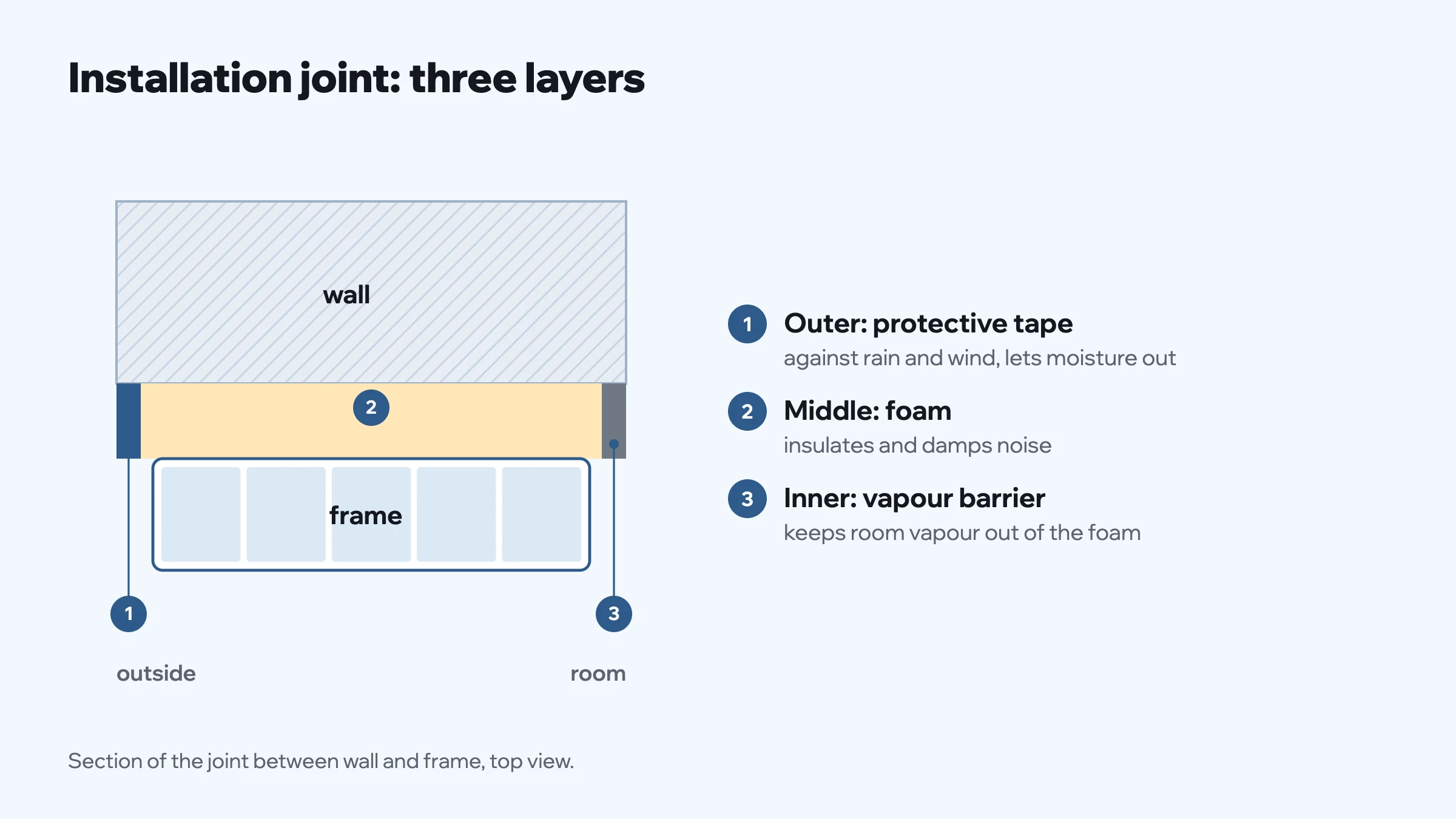
It closes the gap between the frame and the wall, and a sound joint has three layers:
- the middle layer insulates and damps noise;
- the outer layer shields against rain, wind and sun and lets moisture escape;
- the inner layer stops vapour from reaching the insulation.
Without a vapour barrier, indoor moisture gets into the foam. Ask what goes into each layer and have it written down.
What happens at the site measurement?
The installer takes the width, height and depth of the opening and checks the reveal and the condition of the wall. This gives the frame size, the fitting gap and the length of the outer drip sill. Ask for a copy of the measurement sheet, and clear up any gap between the quote and the measurements before you sign.
Sills and reveals
These are priced separately. Ask about the inner sill material, depth and colour. The outer drip sill covers the bottom of the joint from outside: do not accept the work without it. Reveals are finished with plaster or panels, so ask which option is in the price.
Apartment or villa?
In an apartment building, an accurate measurement, removal of old frames and finishing work matter most. For a villa, ask early about the production time for the whole batch. Comparing several quotes with the same specification shows which windows suit you and where the price difference comes from.
Common mistakes
- Accepting "high performance" without test classes on paper.
- Accepting a noise figure without asking whether it is the Rw of that exact window.
- Choosing a narrow frame for triple glazing.
- Accepting an installation without a vapour barrier.
- Comparing quotes with different items included.
Questions to ask before you sign
- Which frame system is it, and is the aluminium thermally broken?
- Which classes did it reach for air permeability, watertightness and wind load?
- What is its Rw with the glazing on offer?
- What is the glazing formula, and is there an energy-saving coating?
- Who makes the hinges, and how many locking points are there?
- How is the joint between frame and wall built?
- Does the price include removal of old frames, waste disposal and finishing?
- What does the warranty cover, for how long, and where do you file a claim?
What to put in writing is covered in the window installation contract guide, and how to accept the finished work in the installation checklist.
How to compare window companies
Score them the same way: reviews, open prices, years in business and the warranty on installation work. That is how this ranking works; the weights and the calculation are in the methodology.
Questions and answers
Which windows are best for an apartment?
Ones whose model, test classes, glazing and installation method are written into the contract.
Is aluminium or uPVC better?
Neither by default. Aluminium needs a thermal break, uPVC needs thick enough walls; then compare test classes and Rw.
What does Rw mean?
The weighted sound reduction index: one laboratory figure in decibels for how much airborne noise the window blocks.
How do I count the gaps in a glazing unit?
Count the panes and subtract one.
Sources
- European standards EN 14351-1 (windows and external doors), EN 12207 (air permeability), EN 12208 (watertightness), EN 12210 (wind load); ISO 717-1 (airborne sound insulation). Russian standards for frame walls and seals. Checked in November 2026.