
 kna
Published 10 November 2026. Updated 10 November 2026. Editorial team
Windows for hot climates need three things. Glass with a low g-value (SHGC), so less solar heat enters. A frame that limits heat flow, such as thermally broken aluminium or reinforced uPVC, fitted with room to expand. And seals and an installation joint rated for heat that keep dust out. Shading outside the glass helps all three.
In short
- Glass sets how much solar heat enters: compare it by g-value.
- Shade air temperature in Abu Dhabi reaches 48 °C in August; frames and seals need a temperature rating above that.
- uPVC moves about twice as much as aluminium with temperature.
- Close-fitting sashes and complete seals keep sand and dust out.
- External shading reduces heat gain before it reaches the glass.
How hot does it get, and why does it matter for windows?
The National Center of Meteorology publishes long-term averages for its stations. At the Abu Dhabi corniche station, for 2003 to 2025:
| Month | Highest, °C | Mean daily maximum, °C | Lowest, °C |
|---|---|---|---|
| January | 31.3 | 22.8 | 12.9 |
| July | 47.9 | 38.9 | 28.5 |
| August | 48.0 | 40.0 | 29.1 |
| December | 31.6 | 24.9 | 12.6 |
Average maximum relative humidity there stays between 75 and 80 % in every month. For windows this means a long season of strong sun on the glass, a wide gap between outdoor and indoor temperature in air-conditioned rooms, and humid air on the coast. These are shade air temperatures.
Which glass blocks solar heat?
The Abu Dhabi green building rating Estidama splits a building's external heat gain into three parts: solar gain, conduction through the envelope and outside air leaking in. Windows take part in all three, and the glass controls the first one directly.
The figure to compare is the g-value, called SHGC in American documents. Estidama defines SHGC as the share of solar heat that enters a space through glass compared with the solar radiation falling on it. It runs from 0 to 1, and most windows fall between 0.2 and 0.7: the lower the figure, the less solar heat comes in. It is measured for glass under the European standard EN 410, which covers clear, tinted and reflective solar control glass.
The second figure, the U-value, describes heat conducted through the glass. Estidama's own worked example shows both side by side: the proposed building has glazing with an SHGC of 0.22 and a U-value of 2.2 W/m²K, against 0.25 and 6.81 in the baseline. Ask for both figures for the exact glass you are offered, and for light transmittance, so the room does not end up dark. How coatings and tints work is explained in the guide to double glazed windows.
Which frames do not warp in the heat?
Every frame material expands as it warms. In a reference table of expansion coefficients, PVC is listed at 52 and aluminium at 23.1 millionths of its length per degree. Between the lowest and highest air temperatures recorded at the Abu Dhabi corniche, 12.6 °C and 48.0 °C, a 2 m frame would change length by about 3.7 mm in uPVC and about 1.6 mm in aluminium.
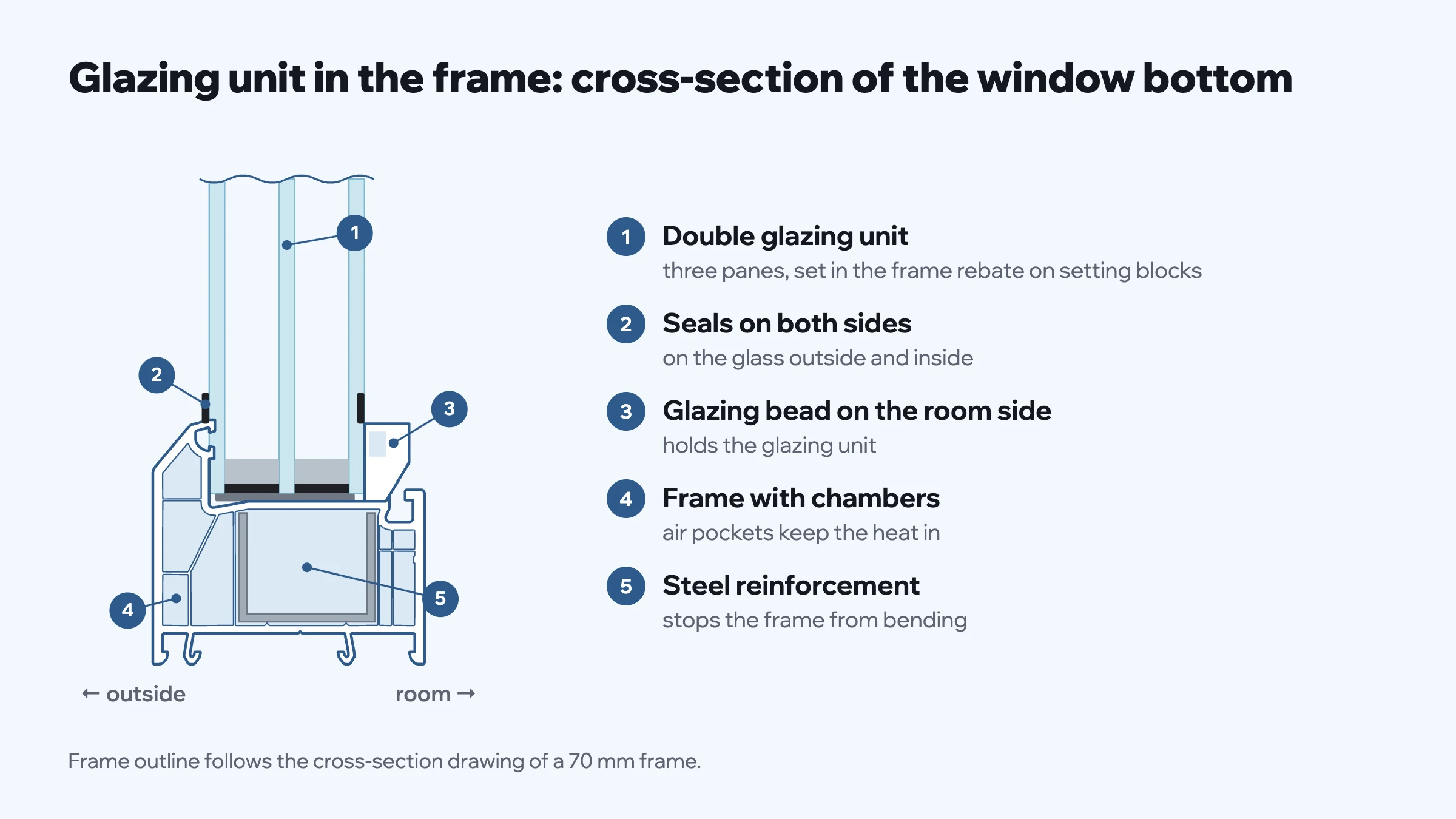
A good installation leaves a gap for this movement and fixes the frame so it can move without bending. For uPVC, steel reinforcement keeps the profile straight, and colour matters: the European profile standard EN 12608-1 covers light coloured surfaces separately, and dark frames are usually white profiles with a coloured foil. Ask which colour option the system maker allows for sunny facades.
For aluminium, the thermal break is what limits heat flow through the metal into a cooled room. Its strength is tested under EN 14024. The two materials are compared in detail in aluminium vs uPVC windows.
Which seals hold up in summer?
Seals sit in the gap between sash and frame and take the full heat of the sun on the outer side. They differ by polymer and by the highest temperature they are rated for. As an example, the Russian standard GOST 30778 rates EPDM, silicone and chloroprene seals up to +80 °C and thermoplastic elastomers up to +70 °C. Ask which polymer the window uses and what temperature it is rated for, and check that the seals run round the whole sash without gaps.
How do you keep sand and dust out?
Before a sand storm, the National Center of Meteorology advises closing all windows firmly, and during the storm, staying away from glass windows and doors. A window that cannot close tightly lets dust in on every windy day, not only in storms.
- Sashes should press evenly on the seals at every locking point.
- Sliding sashes need brush seals that touch the frame along their whole length.
- Drainage slots in the bottom track must stay clear so water and sand can leave.
How to test this at handover is shown in the window installation checklist.
What does external shading add?
Estidama lists external shading among the passive design measures that reduce a building's heat gain, next to orientation, the share of glazing on the facade and glass SHGC. Its worked example uses 1.5 m overhangs above the windows. For a home, that means awnings, overhangs, external blinds or shutters stop part of the sun before it reaches the glass, so they work together with good glass rather than instead of it.
Why does the installation joint matter in the heat?
The gap between frame and wall is closed in three layers. The outer layer protects the joint against rain, sun and dust and lets moisture escape; the middle layer insulates; the inner layer stops vapour from reaching the insulation. Ask what material the outer layer is made of and whether it is rated for sun exposure, and check it is continuous all round.
Questions to ask the installer
- What are the g-value, U-value and light transmittance of the glass?
- Is the aluminium thermally broken, or the uPVC reinforced with steel?
- Which colour options does the system allow for sunny facades?
- What are the seals made of, and to what temperature are they rated?
- How is the frame fixed, and what gap is left for expansion?
- How do the sashes seal against dust, and where does water drain?
Window companies are compared by prices, warranties and reviews in the Dubai window company ranking. The general choice of windows is covered in which windows are best for your home, and the paperwork in the window installation contract guide.
Questions and answers
What are the best windows for hot weather?
Windows with low g-value glass, a thermally broken aluminium or reinforced uPVC frame, heat-rated seals and an installation that allows for expansion.
Are uPVC windows good in hot weather?
Yes, if the profile is reinforced, the colour suits a sunny facade and the frame is fitted with room to expand. uPVC moves about twice as much as aluminium per degree.
What is heat resistant glass for windows?
In practice, glass with a low g-value: solar control coating, tint or reflective layer. Compare the g-value, not the colour of the glass.
How can I protect windows from summer heat?
Choose glass by its g-value, add external shading on sunny facades, and keep seals and drainage in good order.
Sources
- National Center of Meteorology, Climate Yearly Report (Abu Dhabi corniche, 2003 to 2025) and sand storm guidance. Pearl Building Rating System, Design and Construction, version 1.0, Abu Dhabi Urban Planning Council. European standards EN 410, EN 12608-1, EN 14024. Russian standard for window seals. Reference articles on solar gain and thermal expansion. Checked in November 2026.