
 kna
Published 10 November 2026. Updated 10 November 2026. Editorial team
Before you sign off new windows, check five things: every sash opens and closes smoothly, the frame is straight with equal diagonals, the glass and seals are undamaged, water drains out of the tracks, and the joint around the frame is filled without gaps. Write every defect into the handover document with a date to fix it, then sign.
In short
- Check the joint before trims and plaster cover it.
- Open and close each sash several times.
- Run water through the tracks of sliding windows.
- Photograph the markings and every defect.
- Do not adjust or repair anything yourself before handover.
What to bring
- The contract, the quotation and the drawings or measurement sheet.
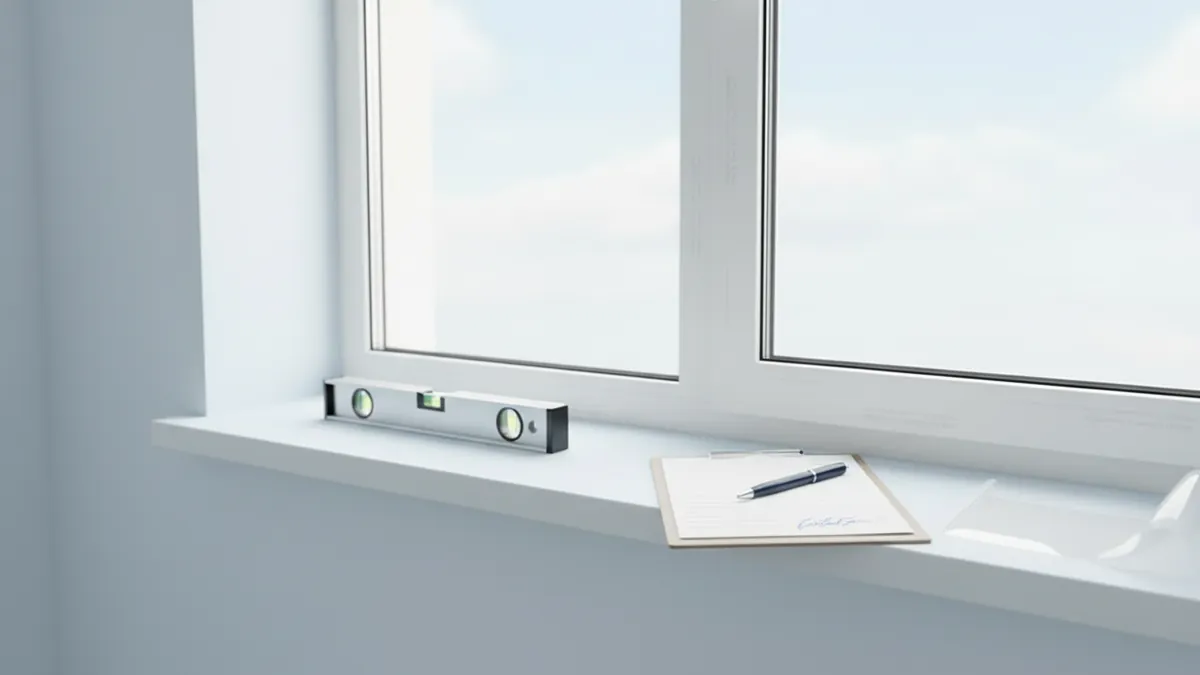
- A tape measure, a torch and a straight edge or spirit level.
- A bottle of water for the drainage test.
- A phone for photos.
Does the delivery match the quotation?
Start with the paperwork. Compare each window with the quotation: size, number and type of sashes, colour, glass and hardware. Profiles, glass units, hardware and seals usually carry a marking; on uPVC frames it is often on the inner side of the frame, in a recess. Photograph the markings and the label on the glass unit, if there is one. A window that differs from the quotation is a defect, even if it works.
How do you check the sashes and hardware?
Open and close every sash at least five times, in every mode it has: side-hung, tilt, sliding. The movement should be smooth and even. A sash that sticks, rubs against the frame or needs force to lock goes on the defect list.
- Handles turn fully and the sash locks at every point.
- Sliding sashes run on their rollers without jumping or grinding.
- Tilt and turn sashes do not drop when opened.
- Child locks, limiters and insect screens work as ordered.
Leave adjustment to the installer. Repairs made by the owner before handover can give the installer grounds to refuse a warranty claim later.
How do you check the frame?
Measure the width and height of each window and both diagonals. Run a finger along the corners and the joints between profiles. Standards set tolerances for these. The Russian standard for aluminium windows, GOST 21519, for example, allows:
| Check | Tolerance |
|---|---|
| Overall size against the drawing | +2.0 mm / −1.0 mm |
| Difference between diagonals, side up to 1,200 mm | up to 1.0 mm |
| Difference between diagonals, longer sides | up to 2.0 mm |
| Offsets and gaps in the corners | up to 0.5 mm |
| Straightness of edges | up to 1 mm per metre |
For uPVC windows, the Russian standard GOST 30674 allows an offset between profiles of up to 0.7 mm at welded corners and up to 1.0 mm where a mullion is fixed mechanically. Ask the installer which standard the system follows and which tolerances apply.
Check the coating too: no scratches, dents or patches of different shade, and the protective film removed or ready to be removed.
How do you check the glass?
- No cracks, chips or scratches, and no dust or dirt inside the unit.
- No mist or moisture between the panes.
- The edge sealant is intact all round.
- Faint rainbow lines are acceptable; coloured rings in the middle mean the panes touch.
- Safety glass is where the contract says it should be: ask the installer how it is marked.
Glass types are explained in double glazed windows.
How do you check the seals?
The seals should run round the whole sash without gaps, tears or stretched corners. A simple test shows whether the sash presses evenly: rub chalk on the seal, close the sash firmly and open it again. A continuous line on the frame means good contact; a broken line means the sash does not press there.
Snagging windows in a Dubai or Abu Dhabi home
Snagging is the inspection before you accept a new home or new work. For windows, add three checks that matter in a hot, dusty climate:
- Drainage. Pour water into the bottom track of a sliding window. It should leave through the drainage slots to the outside within a short time, not stand in the track or run into the room.
- Dust. Look for daylight between a closed sash and the frame. Brush seals on sliding sashes should be complete and touch the frame along their length.
- Sun side. Check that the glass on sunny facades is the build named in the quotation, with the coating on the surface stated.
If a defect turns up later, UAE consumer law obliges the provider to repair it, replace the item, refund it or carry out the service again without charge. A dated defect list from handover makes that claim simple.
How do you check the installation joint?
Look at the joint before trims and plaster close it. It has three layers, sometimes four:
- the outer layer: tape or sealant, laid evenly, protecting against rain, sun and dust;
- the middle layer: foam filling the gap completely, without voids, cracks or gaps where it meets the frame;
- the inner layer: a vapour barrier laid evenly round the frame.
If the joint is already covered, ask for photos taken during the work and for the record of hidden work. Check outside as well: the drip sill covers the bottom of the joint, and sealant lines are continuous.
What paperwork closes the job?
Two documents: a record of the hidden work on the joint and the handover of the finished windows. If something is wrong, list each defect with the window number, a short description and a date to fix it. Sign once the list is complete, and keep the photos. Also take the warranty documents for the windows and the installation, and the care instructions.
What should already be in the contract is covered in the window installation contract guide.
Window installation inspection: quick checklist
- Windows match the quotation: size, sashes, colour, glass, hardware.
- Every sash opens, closes and locks smoothly, five times in each mode.
- Diagonals and corners within tolerance, coating undamaged.
- Glass clean, uncracked, no mist inside, safety glass where needed.
- Seals continuous, chalk line unbroken.
- Water leaves the tracks through the drainage slots.
- Joint filled, outer and inner layers in place, drip sill fitted.
- Defects listed with dates, documents and warranties handed over.
Installers are compared by warranty, prices and reviews in the Dubai window company ranking.
Questions and answers
What if a sash is stiff at handover?
Write it down as a defect and let the installer adjust it. Do not adjust it yourself.
When should the installation joint be checked?
Before trims, plaster or panels cover it.
How do I test window drainage?
Pour water into the bottom track of a sliding window and watch it leave through the drainage slots to the outside.
Can I sign the handover with defects?
Yes, if every defect is listed with a date to fix it. Keep the last payment until they are fixed.
Sources
- Russian standards for uPVC windows, aluminium windows, installation joints and glazing units, used as examples of tolerances and checks. UAE Federal Law No. 15 of 2020 on Consumer Protection, article 12. Checked in November 2026.